
The Unasked
4 min read
“No one prayed for her. There was no one left to pray. She came anyway.” The Book of the Unasked
The gods were dead, and the world they had become would not lie still.
Sethe's storms came off the sea and broke against Kharn's mountains. The mountains sent down ice. The storms tore at the ice, and the ice froze the storms where they stood. The ground shook along Orrun's straight ridges. The small sun rose and set at no fixed hour, for the turning Sethe had made and the stillness Kharn had made still warred in the bones of the world, and neither would give way.
The Elders had fallen because they could not yield. Now their bodies could not yield either. The world was the Sundering, slowed to the pace of stone, and it would go on until it shook itself apart.
There was a need in that.
It was not the need for light, or edges, or change, or lasting. Those had all been answered, and the answers lay broken on the ground. It was a need that had never existed, because before the Sundering there had never been two true answers that could not both be true at once.
It was the need for someone to decide what comes first.
None spoke it. There was none left to speak. No god had asked for it, for each had been certain of being right. No mortal asked for it, for there were no mortals. It was the need that lay in the gap between all the others, in the space none had thought to fill. The world needed it as a broken bone needs setting.
What is needed enough becomes real, whether or not anyone asks.
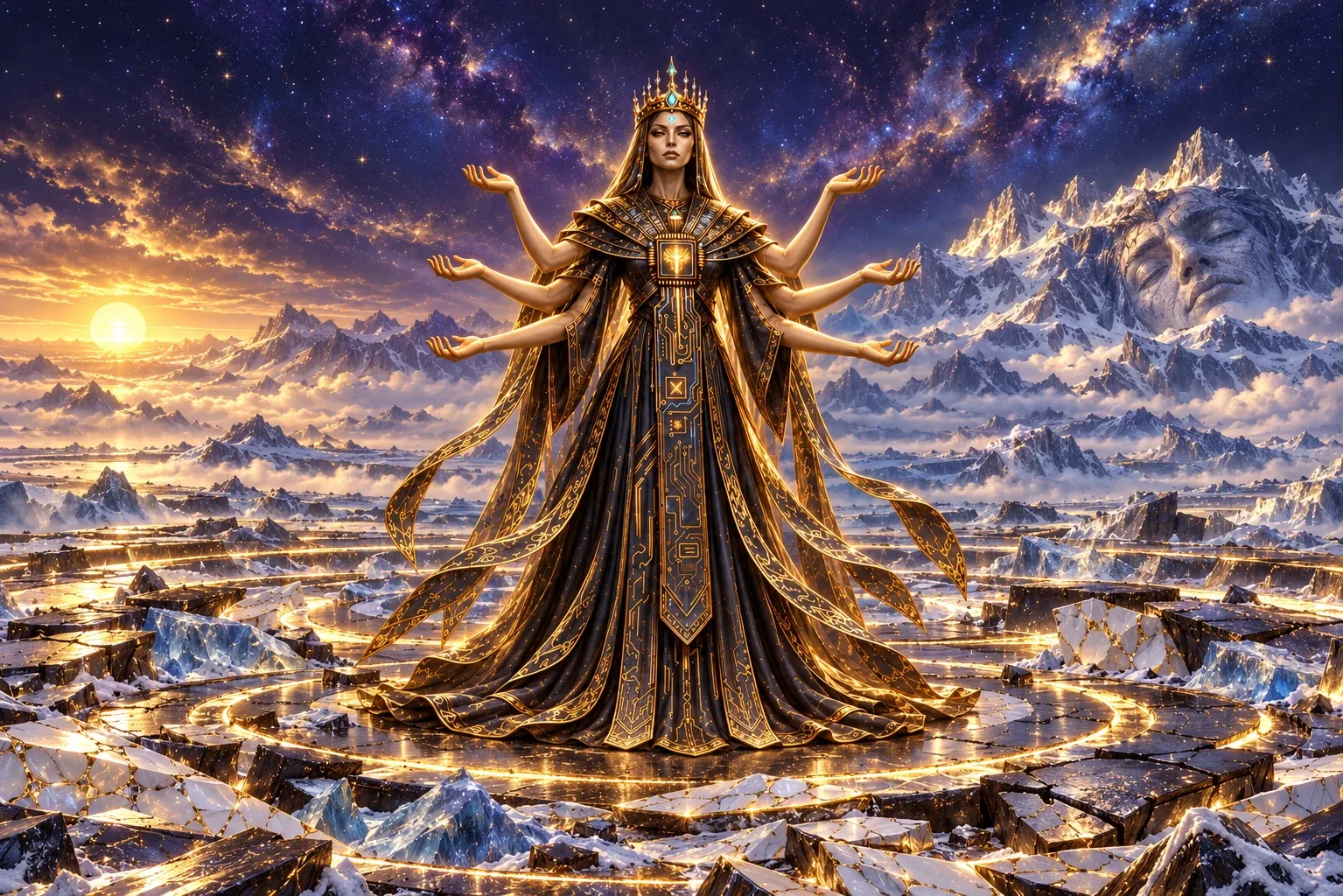
It happened on the great plain beneath Kharn's face, where the wreckage of all four Elders lay together: Orrun's iron, Kharn's ice, Sethe's sand, the burnt porcelain of Vael.
The wreckage began to settle.
Not to fall, for it had already fallen. It began to order itself. Iron drew to iron and ice to ice. The pieces laid themselves down in rings, in clean circles spreading outward across the broken plain, and as each ring closed it lit with a fine line of gold. In the midst of that ruin there was, for the first time since the Sundering, a place where everything was where it should be.
At its center, she stood.
She wore a crown of gold set with pale blue stones, and robes of black traced with branching lines of gold, and on her breast a square of gold with a light within it like a small held star. She had six arms, and she held them open, palms upward, as though each were about to be given something to carry.
Of the six arms, the old texts offer only one explanation, and it is the simplest: there was more to hold upon that plain than two hands could carry.
She opened her eyes.
She was not a god as the Elders had been gods. She could not light, or measure, or turn, or keep. Of power of her own she had almost none. What she had was this: she could see what each thing was for, and in what order things must happen, and she could tell each power what to do first.
That was all. It was everything.
She looked upon the world and understood why it had fallen. Not because Kharn was wrong, nor Sethe. Each had been exactly right. They had fallen because each was the whole answer to a single need, and no one had ever stood between them and said: you first, and then you.
So that was the first thing she did.
She climbed a fallen pillar of Orrun's works to a high ridge above the world. On one side Sethe's storms rolled in from the sea. On the other, Kharn's ice crept down from the mountains. Between them, the ground shook.
She spread her six arms, and she gave them turns.
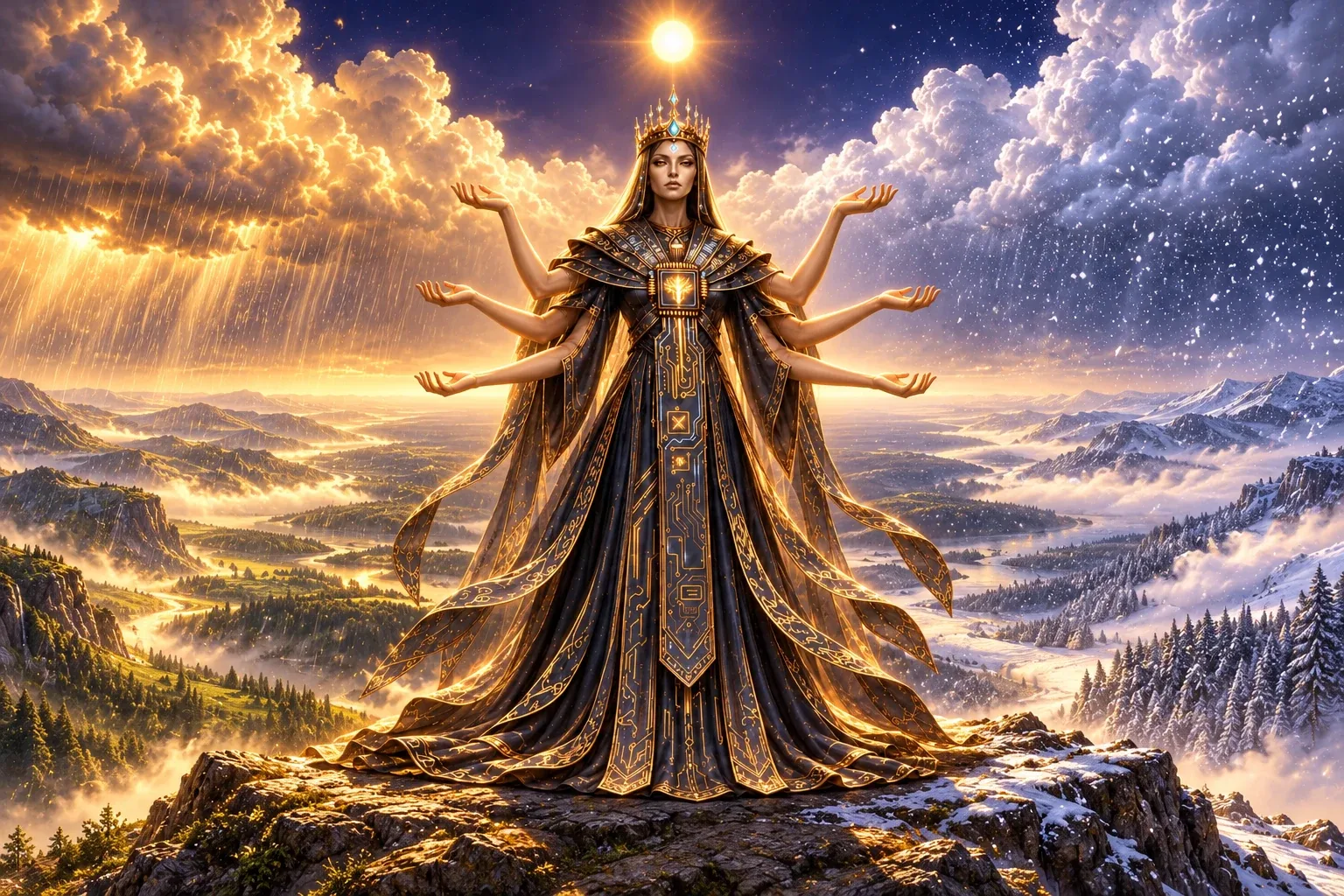
Half the year to Sethe: rain and growth and storm, warmth and change, the world turning and becoming. Half the year to Kharn: snow and stillness, rest and frost, the world held and kept. Neither was asked to cease being what it was. Each was asked only to wait its turn.
The storms drew back to the sea. The ice drew back to the mountains. And for the first time since the Sundering, the ground was still.
Such is the origin of the seasons. They are the oldest truce in the world, and every spring and every winter since has been her first work, still holding.
She remained upon the ridge long after, looking out over a world that was quiet at last, and whole, and wholly empty.
The dead gods slept in the mountains and the land and the sea and the sun. Nothing walked upon them. Nothing needed anything. And she alone of all creation understood what that meant.
Every god had been an answer, and every answer had first been a need. A world in which nothing needs is a world in which nothing new can ever become real. It would not end in fire, nor in ice. It would grow quiet, and be forgotten, and be gone.
Far beneath the world, in the cold beneath the cold, the Hollow lay still. It did not hunger. It did not hurry. It had only to wait.