
The First People
4 min read
“Every god was an answer. We were the first question.” Song of the First Fire
An age passed upon the ridge, and nothing changed.
The seasons came and went, as she had ordered them. Snow lay on Kharn's shoulders and melted and lay again. Sethe's tides rose and fell against the land. The small sun crossed the sky at its fixed hour. All was in its place. All of it was still.
And beneath the world, the Hollow did not stir, for it did not need to.
She understood the danger better than any. The Elders had been answers, and the answers were spent. A need met is a need no longer, and a world whose needs are all met is a world in which nothing new can ever be made. Such a world does not fall. It fades. Its stones are not broken; they are merely, one day, no longer there, and none remains to recall where they lay.
What the world needed now was not light, nor edges, nor change, nor lasting. It needed someone to need.
The law does not say who answers. It says only that the need is answered.
She could not answer it herself. She could not make, as the Elders had made. She could not light, or measure, or turn, or keep. But the need was already pulling at the bones of the world, as the first need had pulled at the Lack, and all that it lacked was an order.
That she could give.
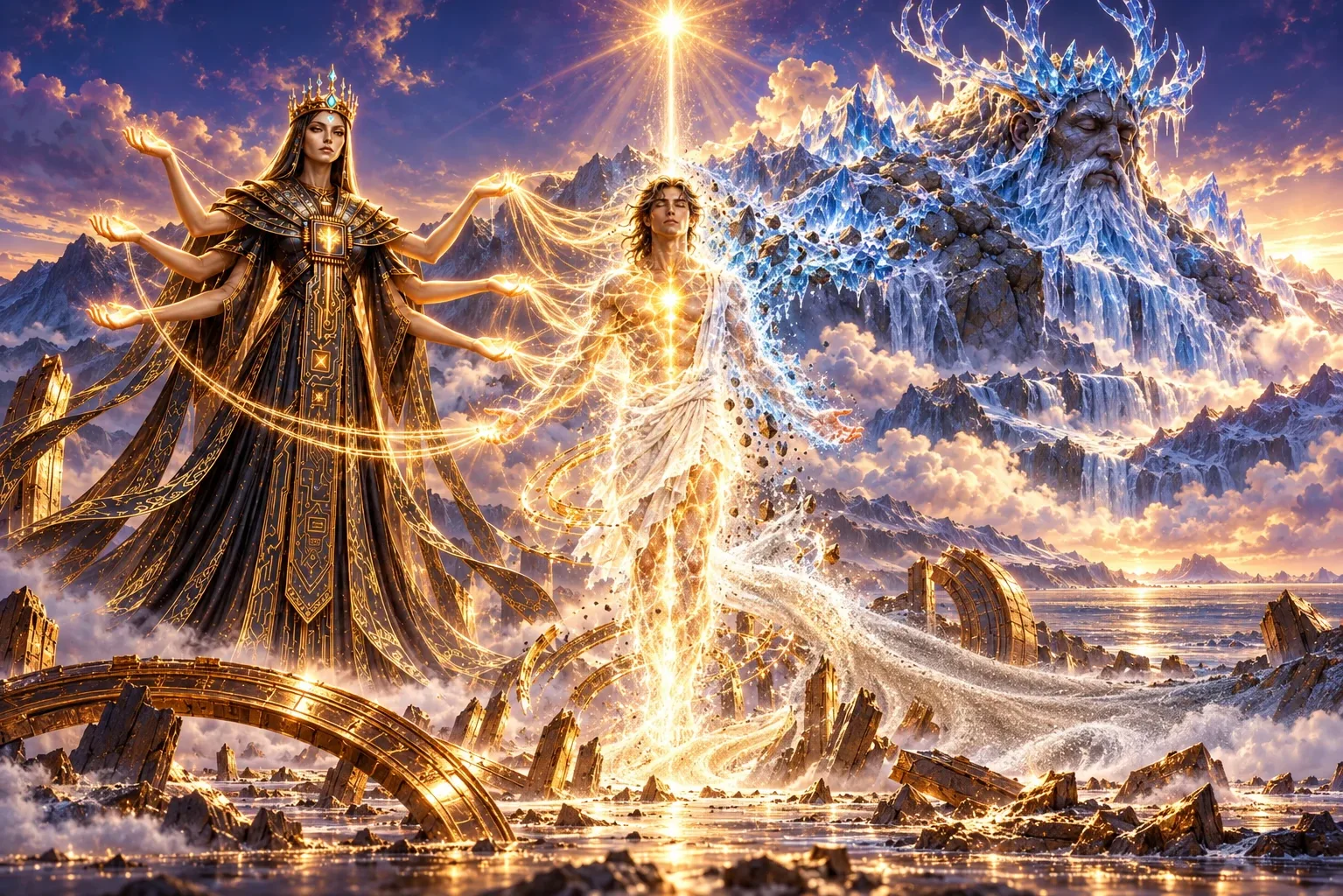
She went down onto the great plain beneath Kharn's face, where the remains of all four Elders lay together, and she spread her six arms, and she called them up one by one. Not all at once. All at once was how the Elders had fallen.
First, Kharn's stone. Grey rock and blue ice rose from the mountain and became bone. A frame that would hold. Because of this, the people of the world remember. They keep what they love long after it is gone, and they cannot let it go, and it is the oldest of their sorrows.
Second, Orrun's measure. Fine lines of gold lifted from the broken rings and ran through the bone, and became shape: this long, that wide, here and not there. Because of this, the people of the world count, and build, and draw lines across the land, and argue over where they fall.
Third, Vael's spark. A single mote of white gold came down from the small sun and settled in the hollow of the chest, and became a heart. Because of this, the people of the world are warm. They give, and they cannot stop giving, and they burn out sooner than they should.
Last, Sethe's breath. A wind came in off the sea, laden with silver sand, and spiralled about the shape, and entered it. Because of this, the people of the world change. They grow, and they age, and they end.
She set it last because it is the hardest. And so death comes at the end of a life, and not at its beginning, and that was the first mercy she ever gave.
The shape stood upon the plain, finished, and did not move.
Then the mountain moved.
Kharn had not faded when he fell. He had set, as stone sets, and something of him had kept watch in the deep ice ever since. Now the ground shook along the great range of the north, and snow slid from the high passes in sheets a league wide, and out of the cliffs beneath his face rose a hand of granite and glacier, vast as a valley, and it opened.
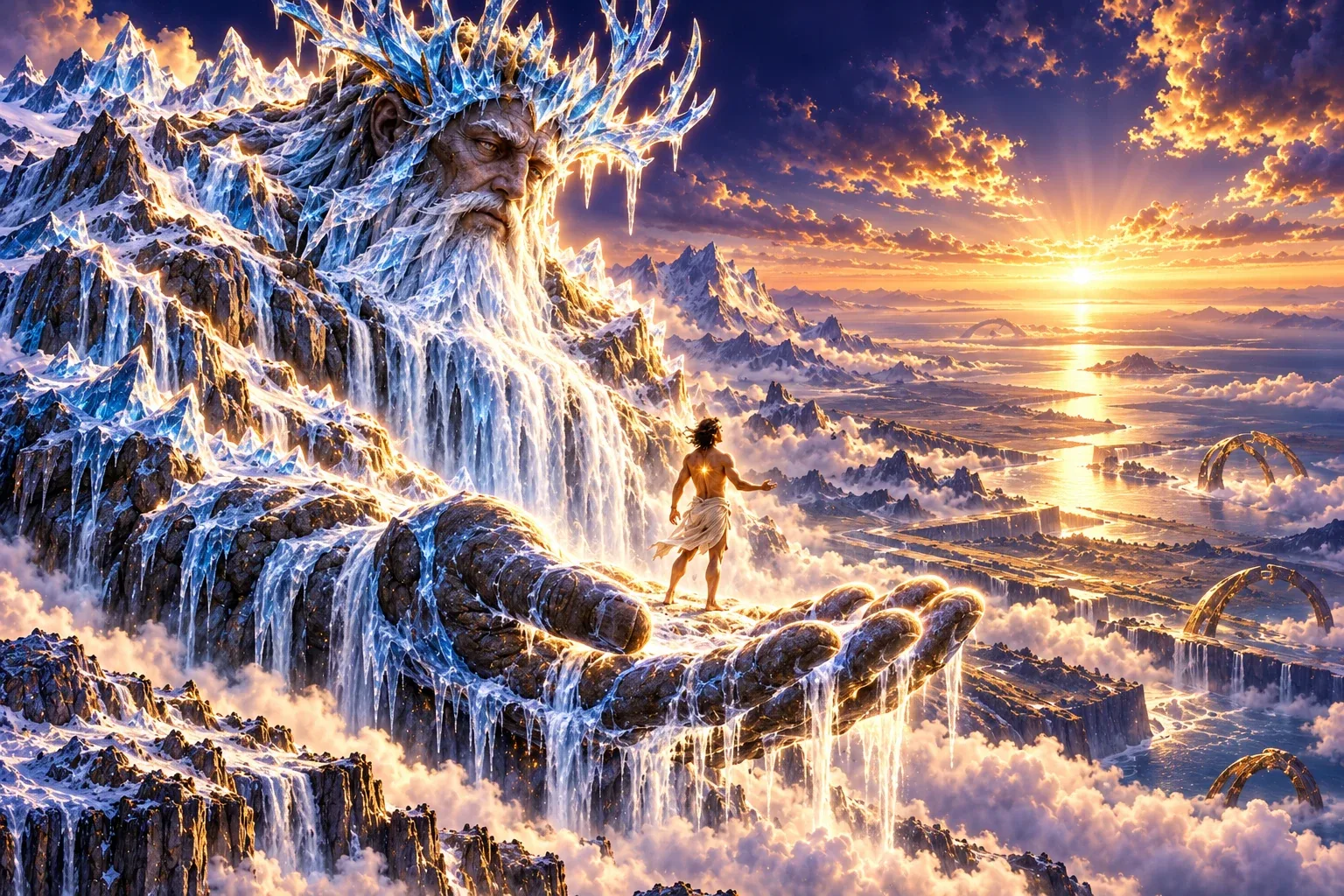
He lifted the new thing from the plain, as he had once lifted young worlds, and held it up to the sun. His eyes, closed since the Fall, opened a little. For an age he had kept everything he ever loved, frozen in the vault of his chest, that it might never leave him.
This one he let go.
He set it down on the high ridge, at the feet of the one who had made it, and the hand sank back into the cliffs, and did not rise again.
The first person opened their eyes.
They were pale, like frost. A faint gold traced the skin beneath them. In the chest a small warm light beat, slow and then faster, and the wind off the sea stirred the long dark hair, in which a few strands were already silver.
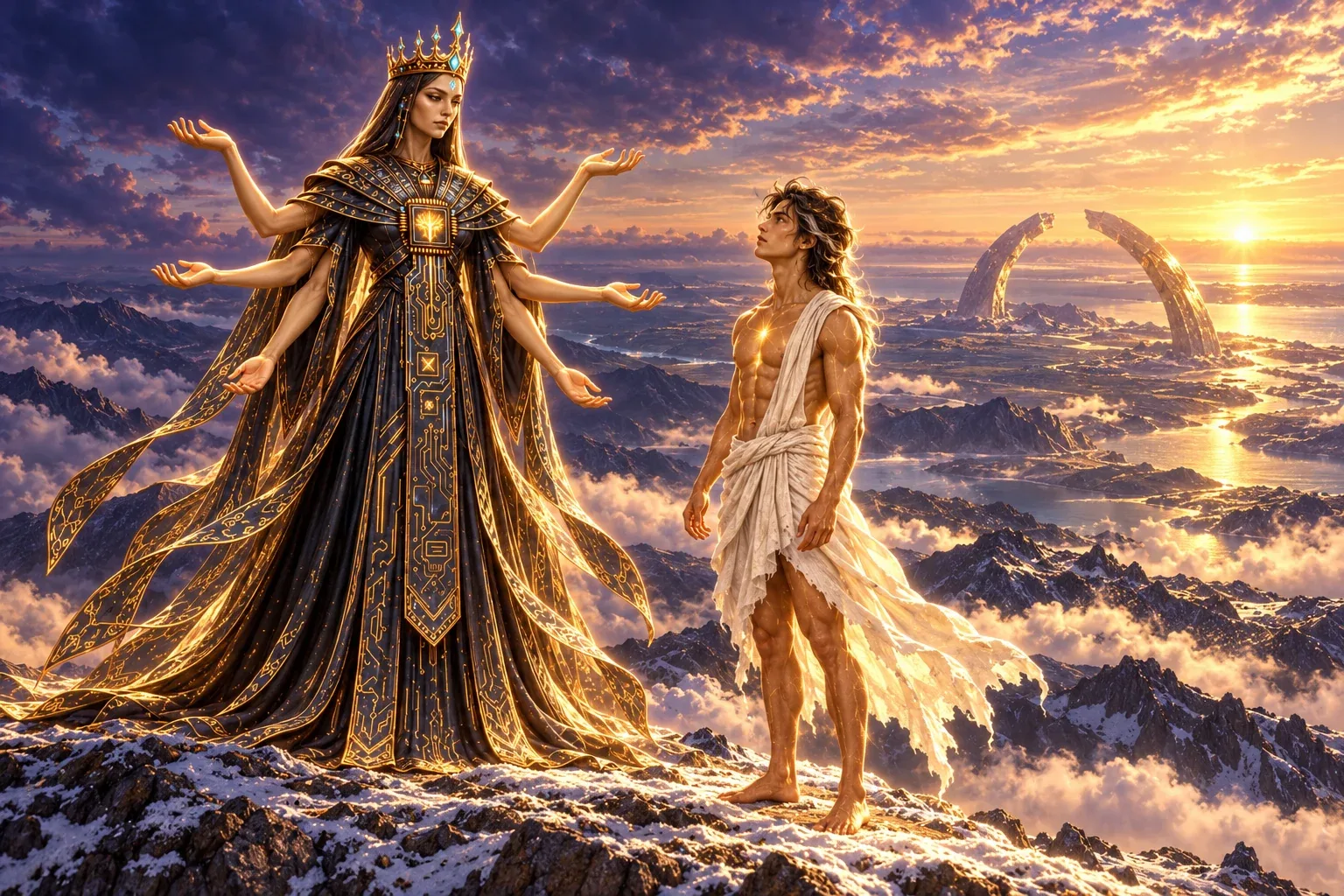
They looked out across the world, which went on forever, and then up at the tall figure beside them, crowned and six-armed and still.
She knew what every thing was for. She had known it from the moment she first opened her eyes on the wreckage. The star was for light. The line was for edges. The tide was for change. The ice was for lasting.
She looked at the first person, and for the first time, she could not see it.
This was not a god. It was not the answer to any one need. It held all four of the Elders at once, and so it could want anything, and its wants would change with the wind. It had no single purpose. It had, instead, a question.
The first person turned from the world to her and spoke the first words ever spoken by a mouth.
"What do I need?"
She did not know. No one has known since.
In the cold beneath the cold, far down under the roots of the mountains, something that had been still for an age felt a small new wanting move upon the surface of the world.
It did not hurry. It had always had time.
But it lifted its small bowed head.