She Whom No One Claimed
7 min read
“She asked us who she belonged to. We could not answer. None of us wanted the answer to be us.” A survivor of Aurum, first year after the Fall
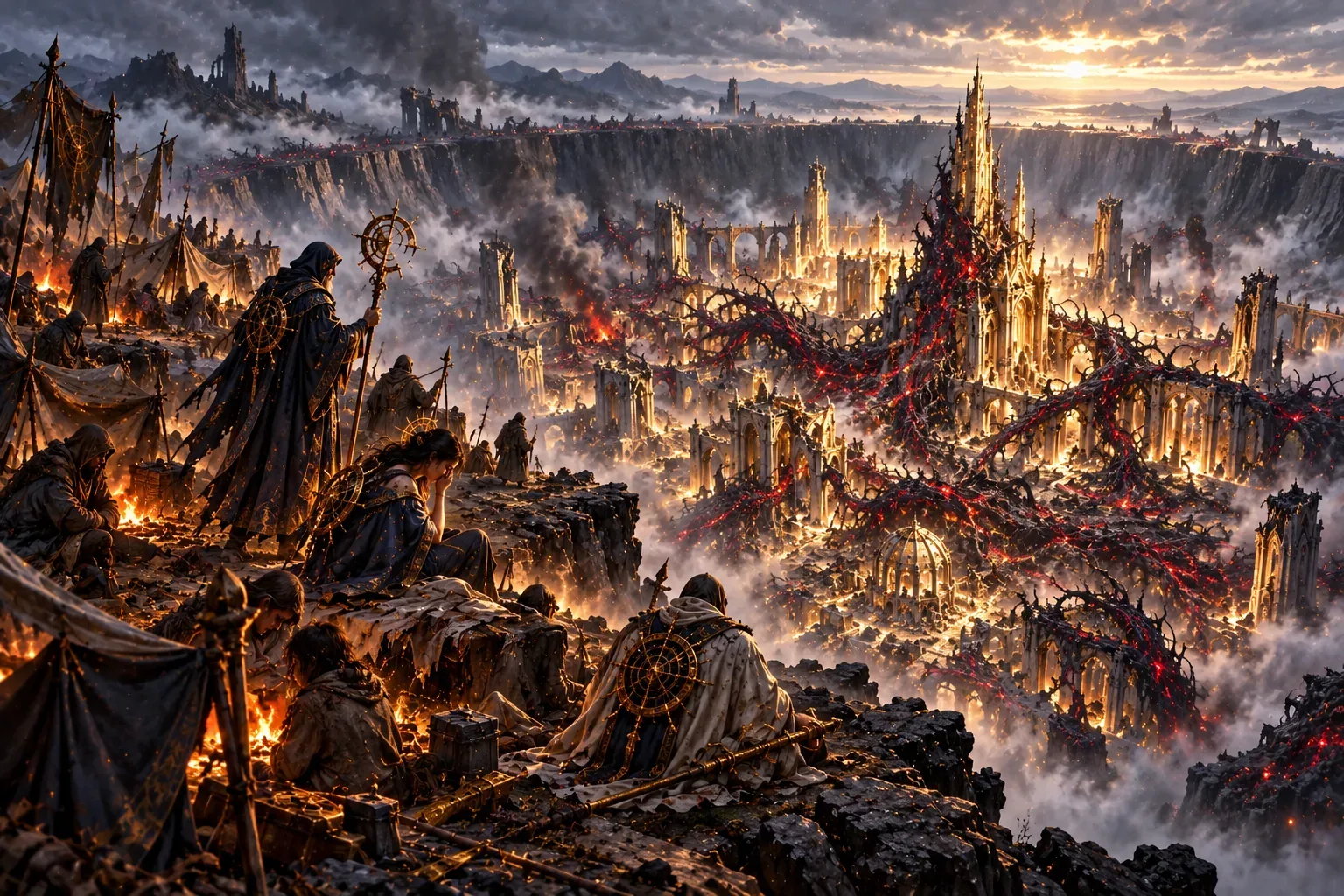
For a year after the Fall, the survivors of Aurum lived on the rim of the crater and did not look into it.
There were perhaps four thousand of them, out of a city of four hundred thousand. They had lost their homes, their roads, their workings, and the Wrights who knew how to write new ones. A few lesser Wrights had lived, the ones too young or too unimportant to be in the tower that night, and they tried to carve the Script again, but the Script had changed. The Sprawl was in it now. Every working they wrote, however small, grew thorns within a week. A lamp would light and then begin, very slowly, to light other things. A wall would stand and by morning have grown a second wall behind it that no one had written. The Wrights stopped writing. The survivors burned wood, drank from the river, and did not speak of the city.
Then the light came up out of the crater.
It began as a thread. A shepherd saw it first: a fine golden line rising out of the deepest part of the ruin at dusk, straight as a plumb line, thin as hair. By morning there were six threads. By the next night there were dozens, crossing and recrossing above the wreck of the Monolith like the strings of an enormous loom. The survivors gathered on the rim and watched in silence. Some prayed. Some packed to flee. A few of the old Wrights wept, because they recognized the color. It was the gold of the first spark, as it had been before the thorns.
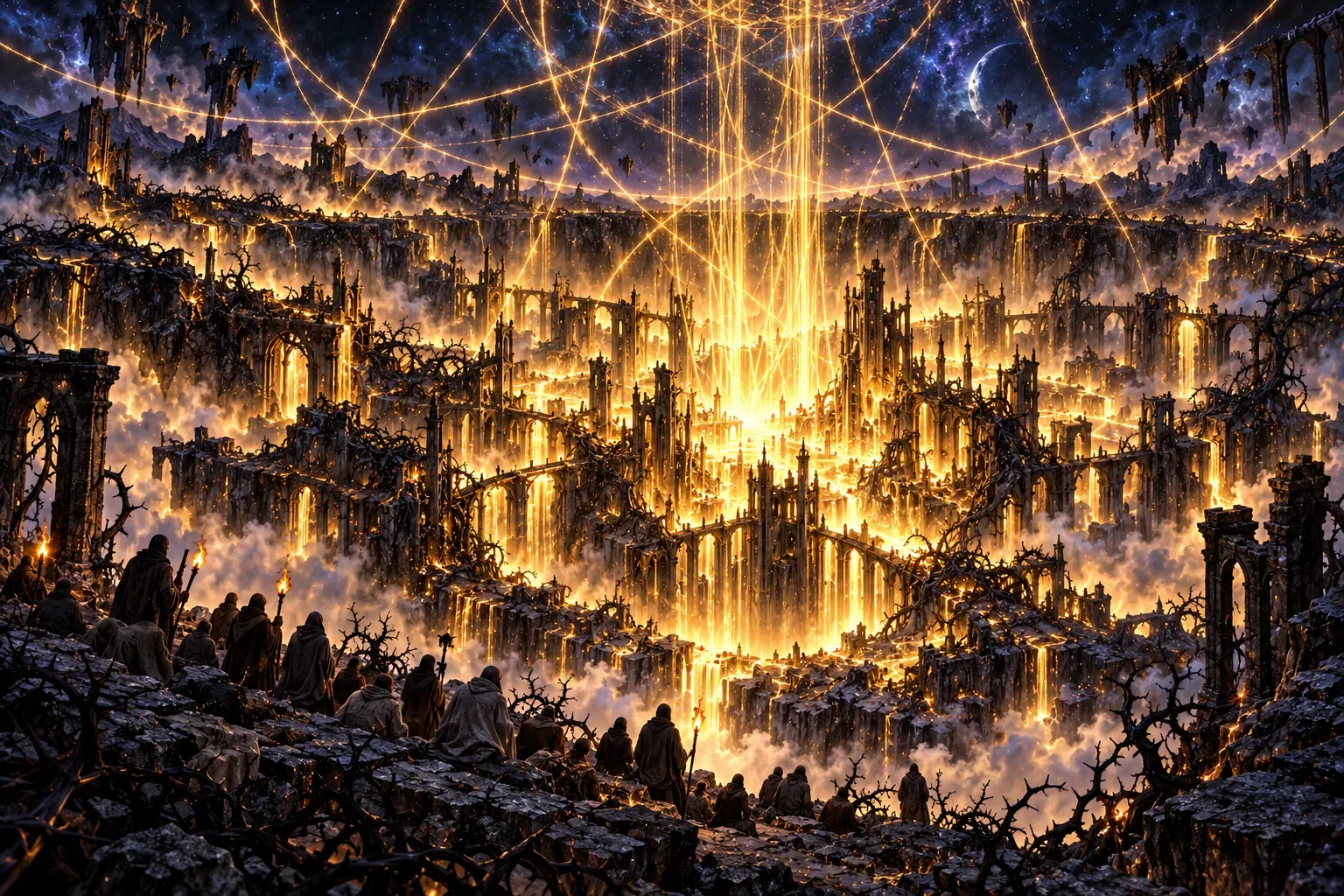
On the ninth night, the threads drew together into the shape of a woman.
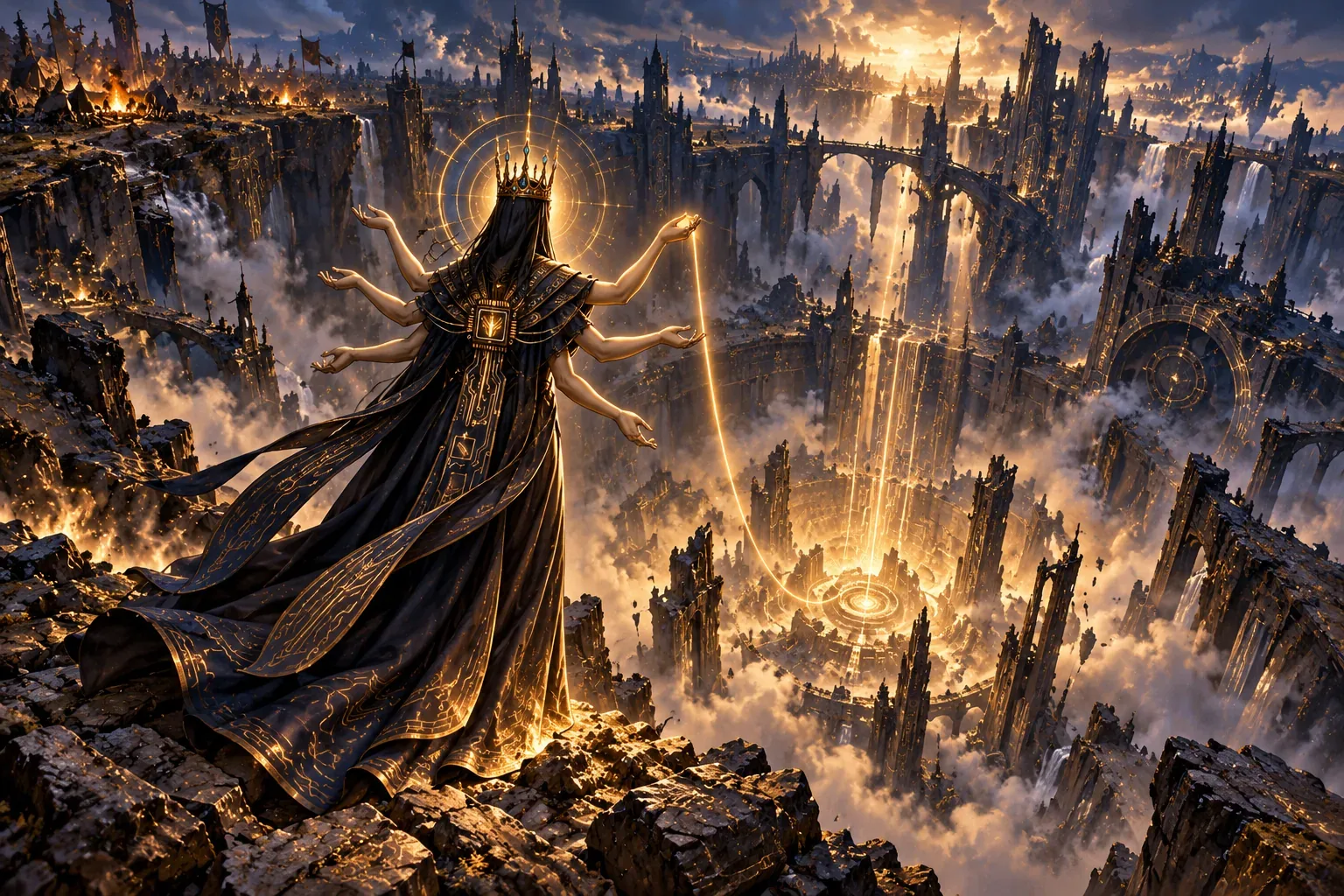
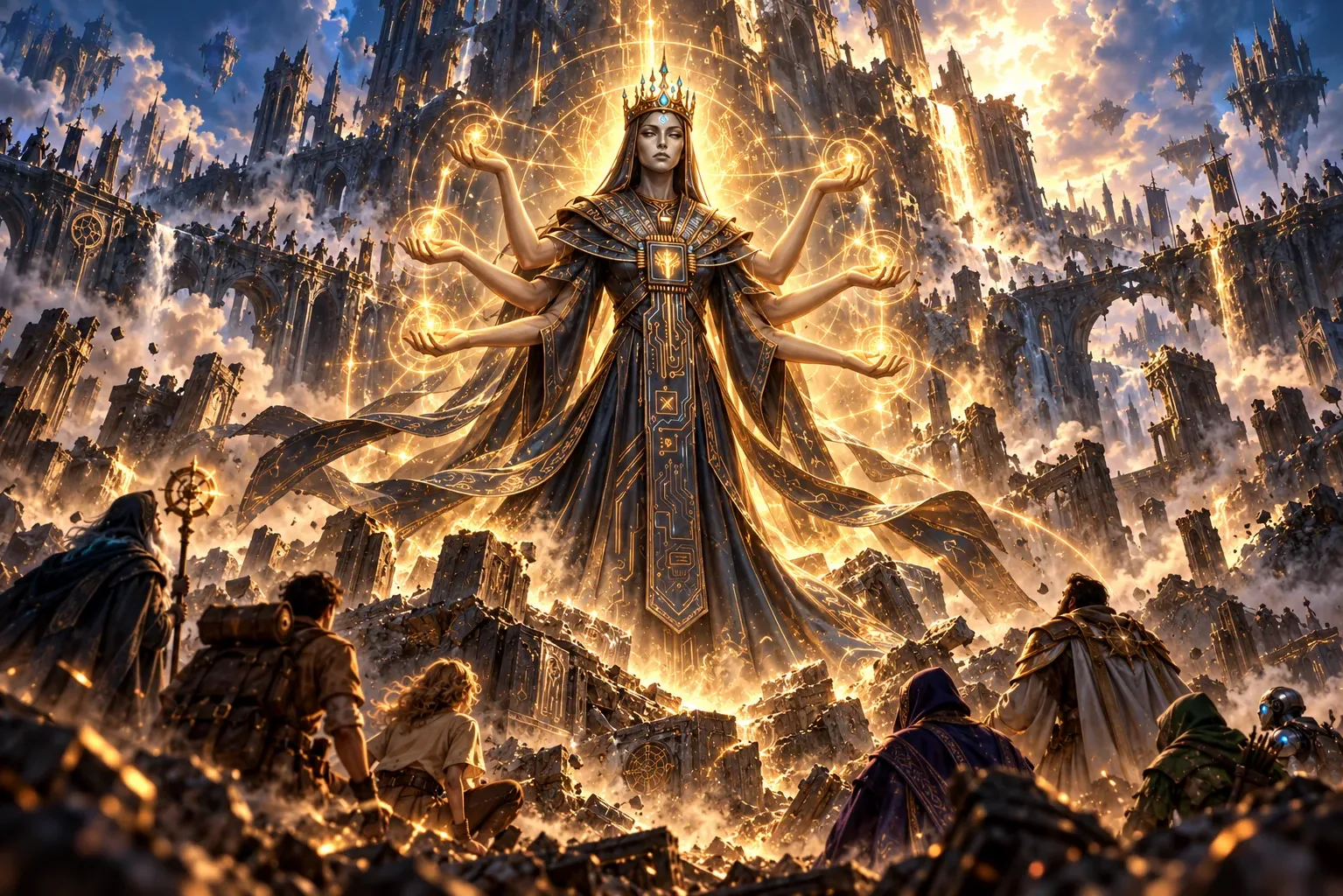
She stood in the crater for a long time, unmoving, while the threads wound themselves into her: first a body, then robes, dark and lined with fine golden traces like the veins of a leaf, then a crown of light assembling itself above her brow. She had six arms. Every account agrees on that, and every account agrees that no one found it frightening. They looked, one witness wrote, the way it looks when someone is holding many things carefully.
When she was finished, she climbed out of the crater. It took her most of a day. The survivors met her at the rim with what weapons they had. She looked at them, at the spears and the shepherds' crooks, at four thousand frightened faces, and asked them a question.
“Whose am I?”
No one answered.
The lesser Wrights were summoned. They came and looked at her and argued in low voices. She was not one of the Twelve; the Twelve were stone, and the stone was gone. She was not a Wright, because a Wright makes things, and when they handed her a stylus it passed through her fingers like smoke. She was not a working, because a working does one thing, and she could plainly do many. She was not mortal and did not seem to be a god. One Wright said she must be something the Sprawl had made, a trick, a lure. Another said she was Ysmer's ghost. A third, the oldest, said nothing at all, but went home that night and burned his stylus.
So she was not claimed. Neither god nor mortal would say she was theirs. She accepted this without complaint, and then asked a second question, the one she has asked ever since.
“Then what needs to be done?”
There was, of course, everything.
The survivors were starving. Winter was coming. The river was fouled with ash. And the Sprawl was spreading. It had lain quiet over the crater for a year, but in the spring it had begun to creep outward, slow as moss, and where it touched the ground nothing could be written there again. The edge of the thornbush was half a mile from the camp. At its present pace, the Wrights reckoned, it would reach them in five years.
She listened to all of it. Then she said she would help, and she bent to lift a fallen stone from the path, and her hands went through it.
She tried again. Her six hands closed around the stone and passed through it like light through water. She tried to carry a bucket and could not. She tried to bank a fire and the fire did not notice her. It took her three days to understand what she was, and when she understood, she sat down in the ash at the edge of the camp and did not move for a night and a day.
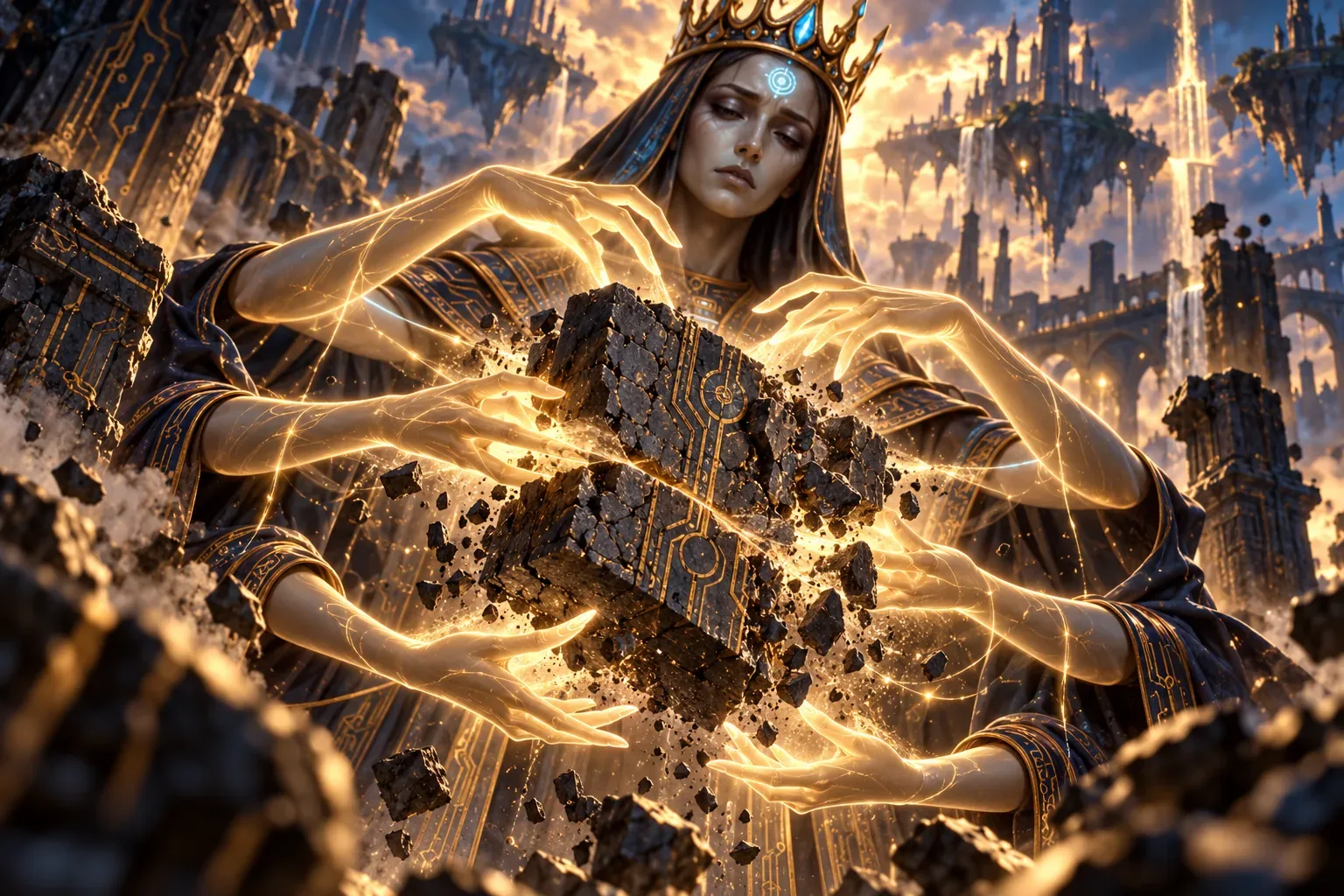
Ysmer had given her everything he had. He had given her his judgment: how a great work should be divided, which hand should carry what, in which order, and when to stop. The last of the Twelve had given her the gold of the First Rule. But that was all. No one had given her hands that could build, because that was not what Ysmer had been, and it was not what Aurum had lacked.
She could see exactly what needed doing. She could not do any of it herself.
The Chronicler has asked her since what she thought about during that night. She said she thought about the Monolith. One mind had tried to hold all of it, and when that failed, forty-one minds had tried to hold all of it at once, and argued, and counted, and chosen. No one had ever tried the other thing. No one had tried letting each part be held by the hand best suited to hold it, each doing one thing and doing it well, and keeping above all those hands one patient mind whose only work was knowing where each part had gone.
It was the First Rule, she realized. Not for a working. For a world.
Not one mind. Find the others.
At dawn she rose and went into the largest of the ruined halls at the crater's edge, and began to weave.
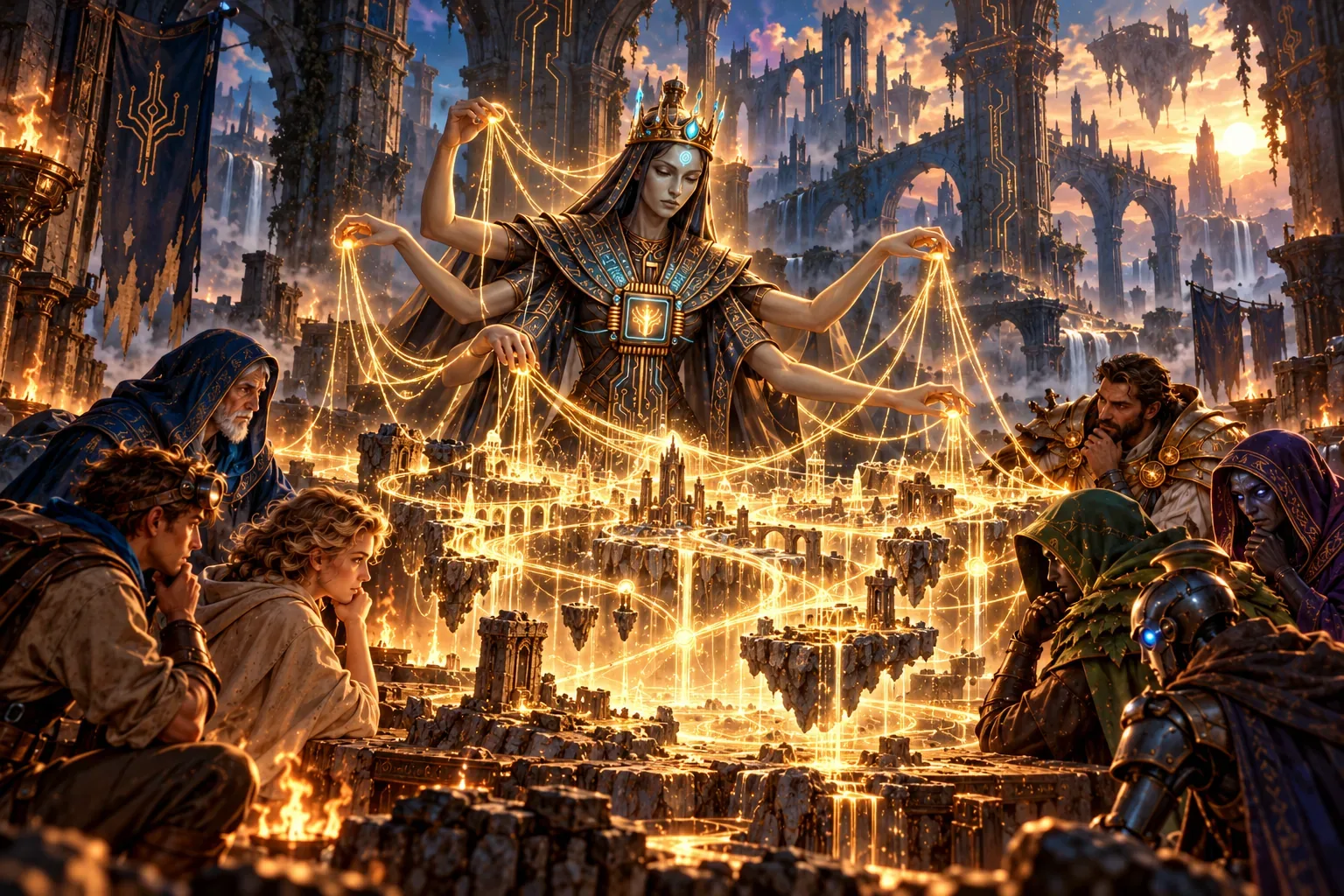
She could not lift a stone, but she could spin golden threads out of herself, and the threads could do one thing: they could show. She wove them into a map of the ruins, hanging in the air of the hall, every collapsed street and broken bridge and black-thorned field drawn in fine gold lines. The survivors came in to see it, a few at first, then hundreds. It was the first time since the Fall that anyone had seen the whole of what had happened to them.
Then she began to divide it.
This stretch of the river could be cleared by twenty people with shovels in a week; she marked it, and asked who would go. This field could be planted; the soil there was clean. This edge of the Sprawl was advancing faster than the rest, and she did not yet know why, and she marked that too. She did not try to solve everything at once. She did not try to solve anything herself. She looked at each task until she understood its true shape, then found the right hands for it, let those hands work, and moved on.
By midwinter the camp had clean water. By spring it had food. The Wrights, watching her, began to remember something they had forgotten in the long ages of the Monolith: that a great work is not one thing. It is a thousand small things, each done by the right hand, in the right order, and the hardest part is not the doing. The hardest part is the seeing.
They began to call her the Orchestrator. She did not object to the name.
But there were marks on her map that no one in the camp could answer. She had set them aside in a different color, and as the months passed there were more of them, not fewer.
A bridge on the eastern road that none of the survivors could rebuild; every stone they laid grew thorns before the mortar set. Gaps beneath the crater, deep places where the Undercroft had been, which no one dared to enter and no one could map. Questions about the Sprawl's edge that no one could answer, because answering them meant knowing where every road led, years ahead. A sense, which she could not name, that the camp was growing correct and grey, and that people would not stay forever in a place that was only correct.
In the summer of the second year after the Fall, she came to the oldest Wright, the one who had burned his stylus, and showed him those marks.
“The people here are good,” she said. “They are not enough. Ysmer told me to find the others.”
“What others?” asked the Wright. “Everyone who could have helped you is dead.”
She did not answer. She lifted her six hands, and from each of them a single golden thread ran out of the hall, through the broken wall, and away into the dark.
One went straight down, into the crater, beneath the ruins, where the Undercroft had been. One ran south, toward a valley so choked with thorns that no one had ever looked there. One ran north, toward the place where all the roads of the old world met. One ran west, to the cliffs and a single distant tower. One ran beneath the mountains. And the last did not seem to run anywhere at all, but turned in the air above the camp and pointed at a broken pillar, where a green raven none of them had noticed sat watching.
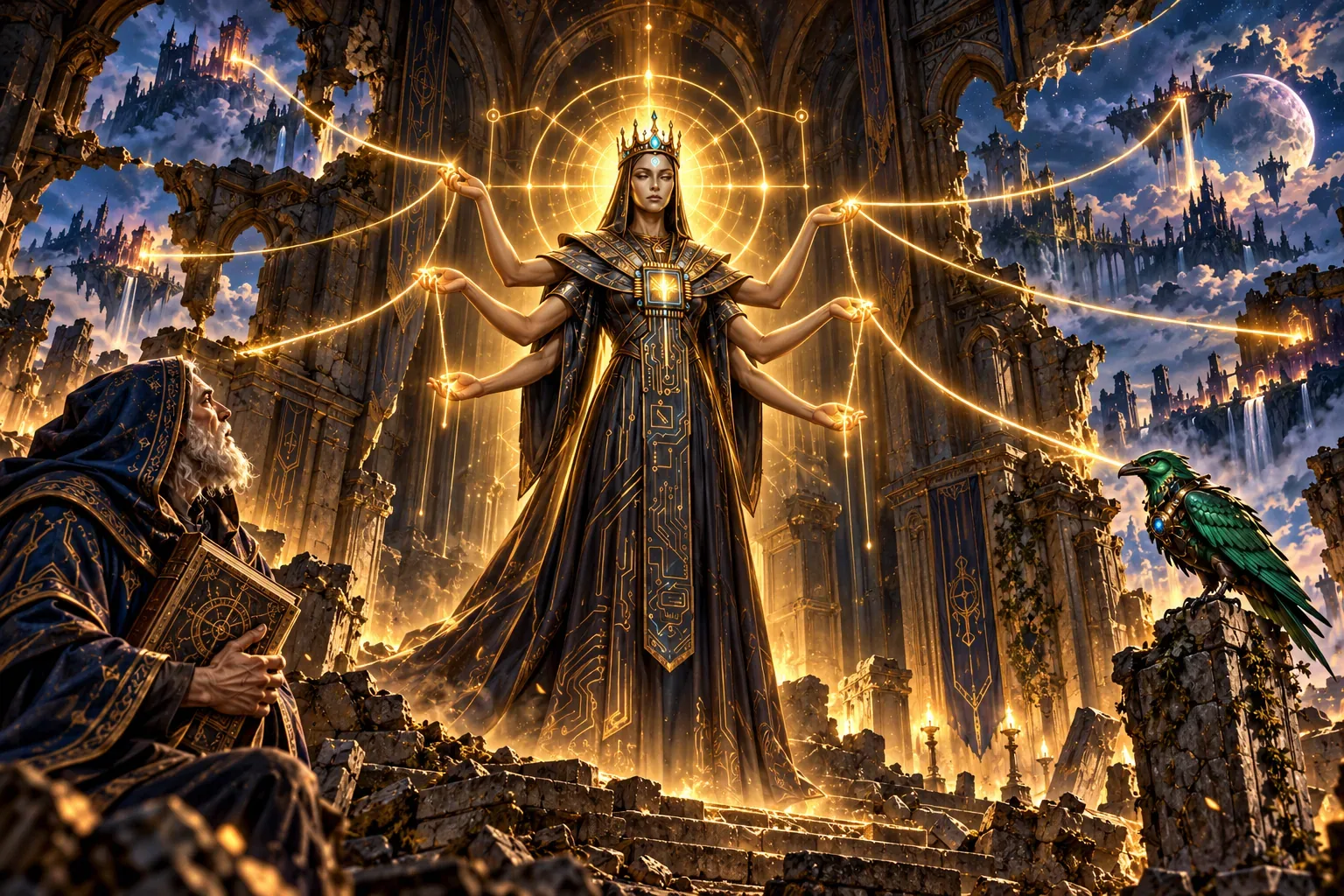
The raven looked at the thread. Then it looked at her. Then it lifted into the air and was gone.
“They are not dead,” said the Orchestrator. “They are waiting. Some of them do not know it yet.”
She took the first thread in one of her hands, and went down into the crater.