
The Small Gods
4 min read
“We prayed for rain, and rain came, with a face. Then we stopped needing it, and the face went out.” Song of the First Fire
The first of the young gods was very small.
A child of the Measured lost a goat in the long grass, and searched for it until dark, and needed, with the whole of a small heart, to find it. Out of the grass a light rose, no larger than a hand, and drifted a little way, and stopped above the place where the goat lay sleeping.
The child found the goat. The light hung there a moment longer, and the need behind it was met, and it went out.
No one marked it. It was the first god born in the age of people, and it lived for the space of an evening.
After that they came without end.
A god of the next rain rose over the fields of the Measured, thin and grey and trailing, and it rained. A god of the one deep well rose in a village of the Held, and the well did not run dry. A god of safe return went out to sea with every boat of the Turning, small and bright upon the prow, and some of the boats came home.
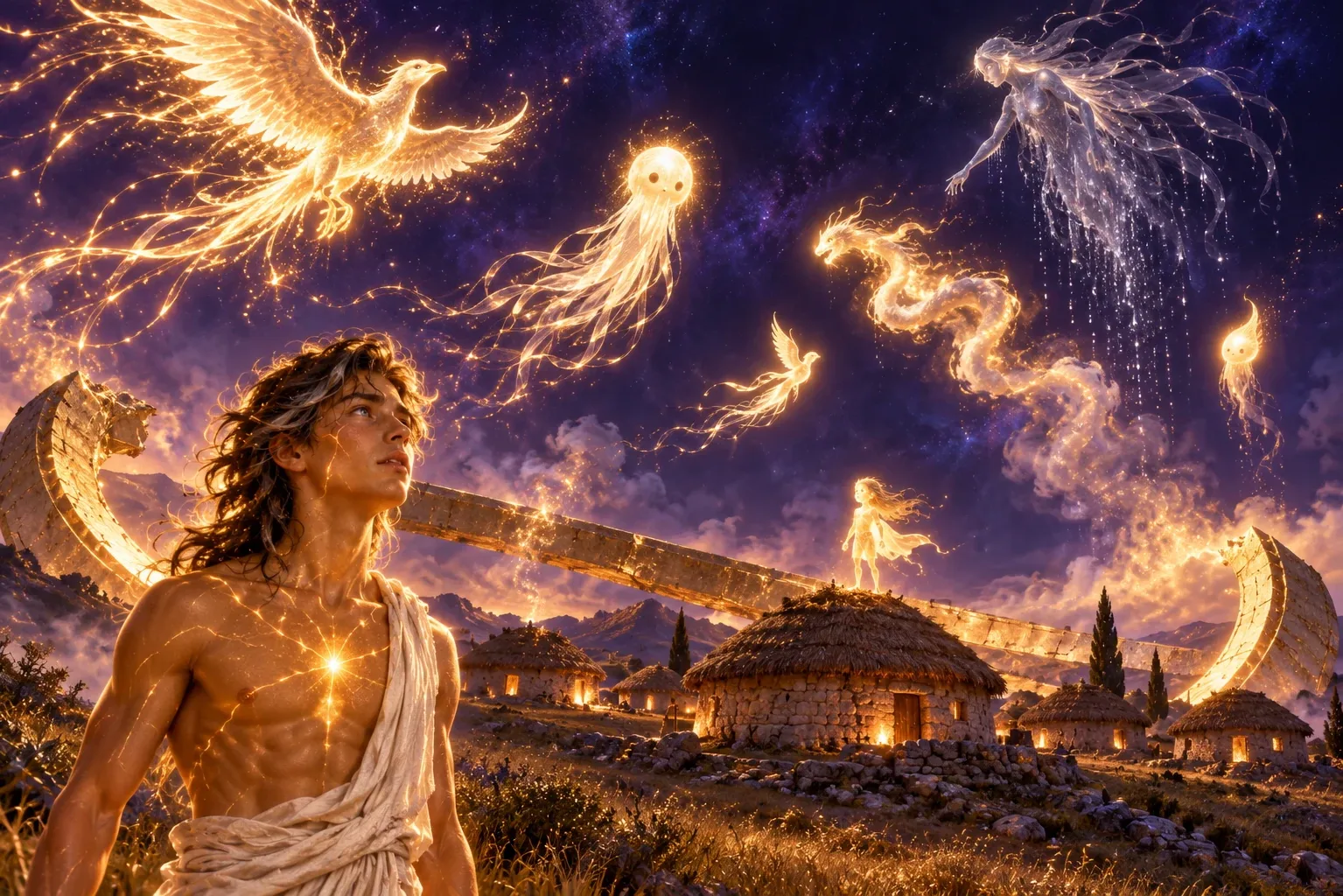
They were nothing like the Elders. The Elders had been answers to the needs of creation, vast and single and slow. The small gods were answers to the needs of people, and the needs of people were many and small and always changing, and so were their gods. Some had faces. Most did not. Some were birds of light, or coils of smoke, or a warmth in a doorway that had no source. They rose wherever someone needed hard enough, and they lasted exactly as long as the need.
When the harvest came in, the god of the next rain thinned, and paled, and was gone. When the well was no longer needed, its god sank into the water and did not come up. They did not die as the Elders died. They simply went out, like lamps at dawn, and the people who had made them never noticed.
A god needed by one is a flicker. A god needed by many is a power.
The world was loud now, in a way it had never been.
At night the plains were full of small lights, rising and drifting and going out. Every village had a dozen gods, and every season a dozen new ones, and every god pulled toward the need that made it, and nothing else. They did not speak with one another. They did not know there was anything to speak of.
And they began to collide.
There was a river that ran out of Kharn's mountains, down between two villages of the Measured. The village on the eastern bank needed it to flood, for their fields were dry. The village on the western bank needed it to stay in its bed, for their houses stood low.
Two gods rose from the same river. One was a thing of brown water and reaching hands that pulled the river up over its banks. One was a thing of stones and roots that held it down. They did not hate each other. They could not. They were each the whole answer to a single true need, and the needs could not both be met.

They fought for a year, and the river went mad between them, and both villages drowned.
She watched it from the ridge, and she knew it.
It was the Sundering. Not the war of Sethe and Kharn, which had broken creation, but the same war, small enough to fit inside a river valley, and happening now in a hundred valleys at once, and soon in a thousand. Every person held all four Elders, and every need they had was answered, and no one had ever stood between the answers and said: you first, and then you.
She went down where she could. She gave the river turns, as she had once given the world its seasons: one flood in spring, and then the bed. She gave the two wells of a village of the Held their hours. She gave the fishing gods of the Turning their tides.
But she had six hands, and the world had more needs than stars. For every quarrel she settled, ten more began where she was not. She could not see them all. She could not reach them all. She had no power of her own, and she had never had to be in two places at once.
She needed to know what was happening in the world, where she was not.
That was the first need she had ever had.
She did not speak it, as no great need is ever spoken. But it went out from the ridge into the dark, and in the dark it found another need, very like it, that had been growing for a long time among the people.
It was the oldest need they had. It was older than the goat in the grass and the rain on the fields. It had been there since the first person stood upon the ridge and looked out at a world that went on forever.
What is out there?
Every village of every people needed it, at the edge of every firelight. Every child who looked past the last field. Every boat that sailed past the last shore it knew.
A god needed by one is a flicker. A god needed by many is a power. And a god needed by many and by the one who decides is something the world had not seen since the Elders.