
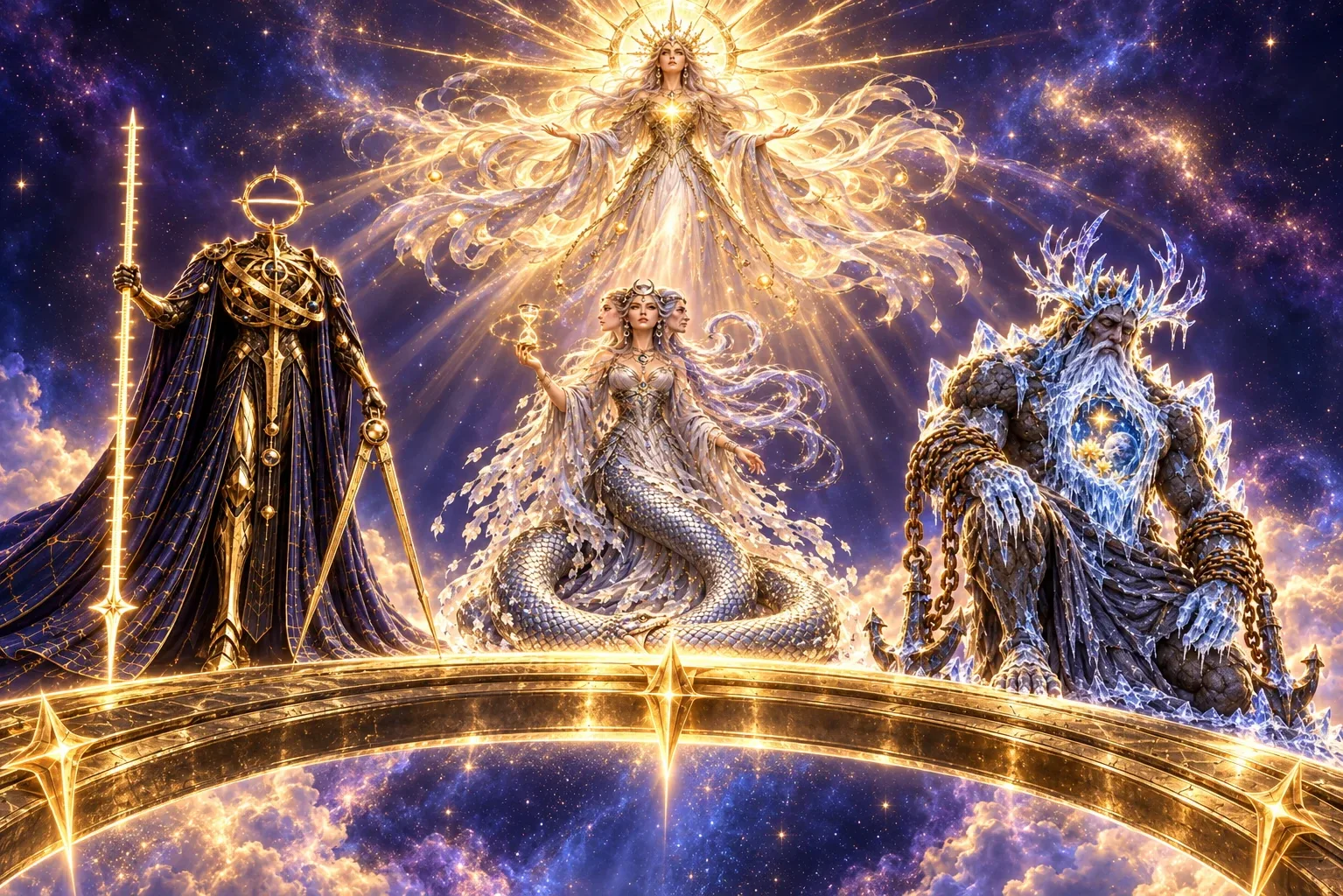
The Elders
4 min read
“One to light it, one to measure it, one to turn it, one to keep it. And none of them to ask what it was for.” The Book of the Unasked
The three needs born of Vael's light grew great, and one by one they were answered. The order of their coming was not chance.
Orrun came first, for light without edges is not a world. It is a blur.
He rose from the place where Vael's light failed into dark, from the very line that no one had drawn. He was tall and lean and perfectly upright, black iron and gold fitted so exactly that no blade could find a seam. He had no head. Where a head should be, a ring of gold hung in the air, and across it lay a single bar of white light, level as still water. About his chest three rings of gold turned slowly, each at its own angle, each engraved with measures. In one hand he bore a rod that was a single straight line of light, notched at perfect intervals. In the other he bore the great golden dividers.
He was the answer to the need for here to differ from there. So he measured.
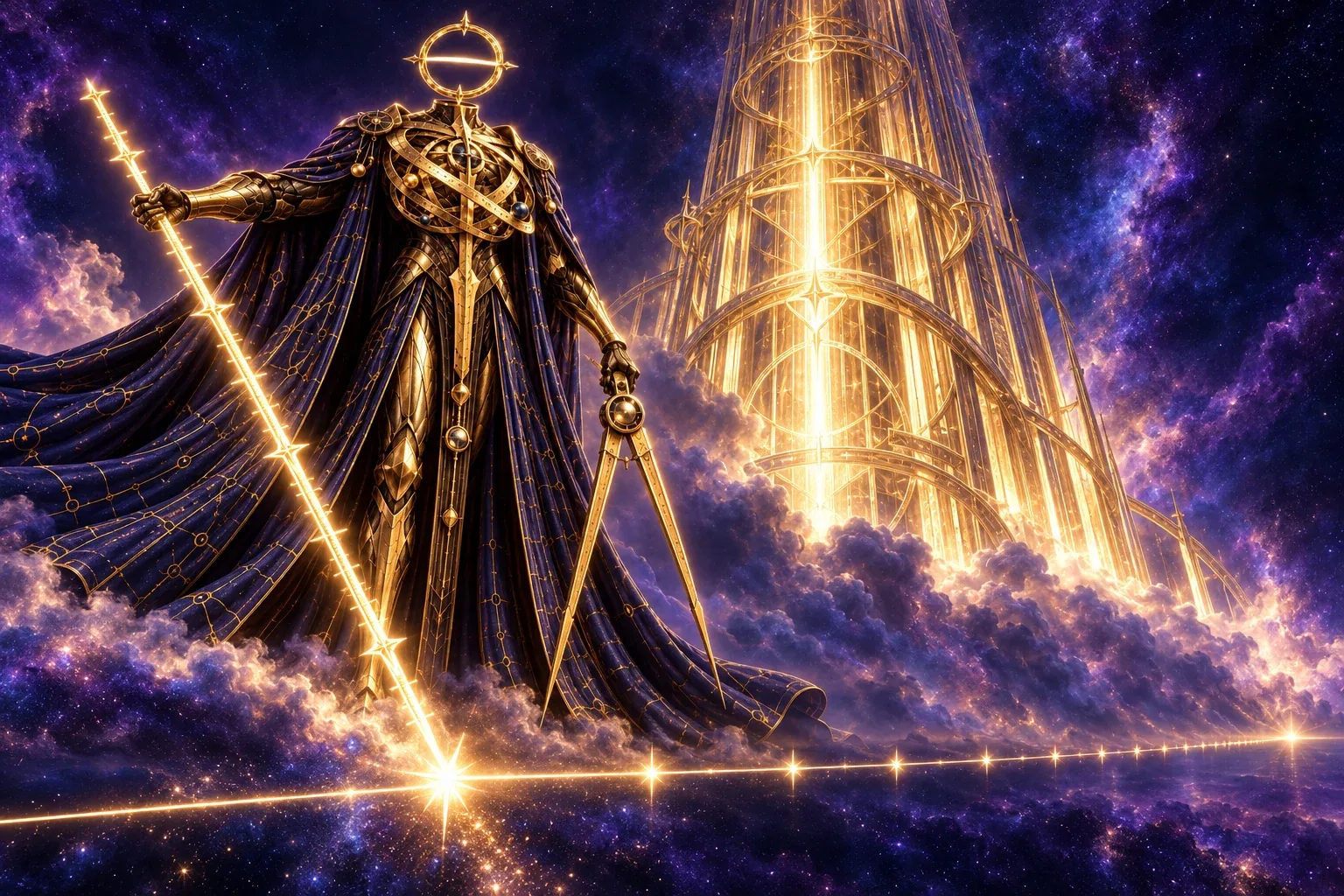
He drew his rod through the mist and a line of gold remained behind it, and on either side of the line lay a different thing. Where the line crossed Vael's spilled light, the light gathered into stars, each in its place, each a known distance from the next.
Then he built. Lattices of gold that ran beyond sight. Rings about the brightest stars to hold them. Roads of light between them. Pillars miles high. A frame for the whole of creation, so that every star had a place and every place a measure. Fragments of those works lie in the earth to this day, and those who dig them up do not know what they hold.
Orrun was patient and exact and cold. He held that every wrong in creation was a question of where the lines should fall.
For an age, he was right.
Sethe came second, for a world that is only ever now is not a world. It is a picture.
She came from the space between one moment and the next, which had not existed until she did. She had three faces. To the left she was a girl, turned toward what had not yet happened. To the front she was a woman in her strength, regarding what was. To the right she was old, looking back on all that had already passed. A silver crescent lay upon her brow. Her hair was a river of silver-blue sand that streamed from her and never ran out, and her robes shed flakes like moths. Below the waist she was a great silver serpent, coiled in a ring with its tail in its own mouth. She was never still.
She was the answer to the need for an after. So she turned.
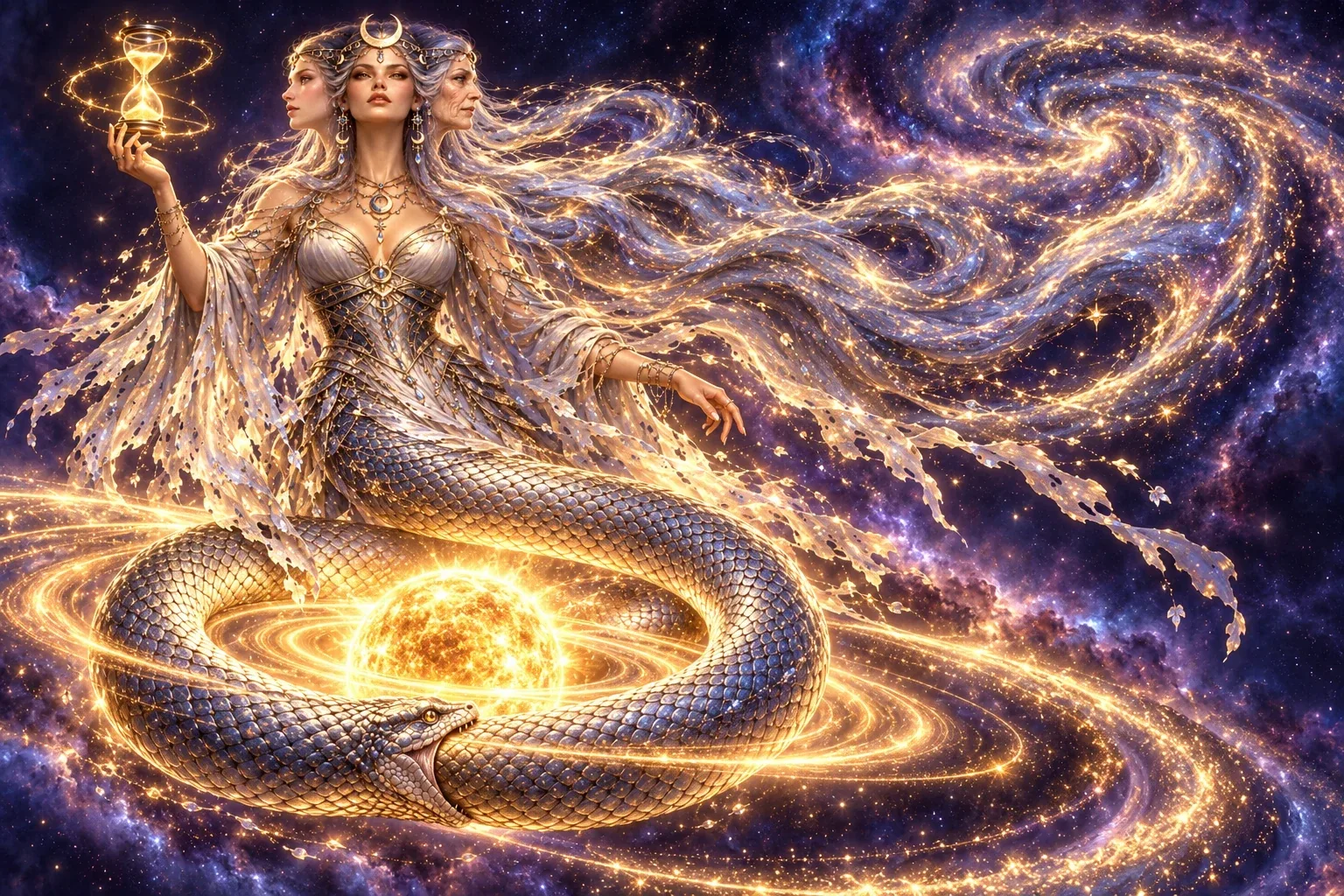
She coiled about the first of Orrun's stars and set it spinning, and the sand of her hair streamed away behind her in a long and glowing spiral, and that spiral was time. In her hand she turned an hourglass of light, and with every turn there was a new after. Before Sethe, every star was where it was. After her, every star had been elsewhere, and would be elsewhere again. She made things grow. She made them change. And, though none yet understood it, she made them end.
To Sethe, a thing kept as it was could only be a thing already dead.
Kharn came last, for a world that only changes is not a world. It is a river, and everything in it drowns.
He was born of the first loss. A spark of Vael's light drifted past Orrun's lines and was turned by Sethe's turning until it went out. None marked its passing. But its passing left a need, small at first and then not small: let it stay.
He was vast and slow, a titan of granite and clear glacial ice who knelt like a guard before a door. Upon his head grew a crown of great antlers of blue ice, and his beard hung down like a waterfall frozen in its falling. His face was old and grave and gentle, and his eyes were seldom open. His chest was a vault of clear ice, and within it, perfectly kept, lay the things he loved, that they might never leave. Chains of iron bound his forearms, and at their ends lay anchors, for he alone in all creation did not drift.
He was the answer to the need for things to last. So he kept.
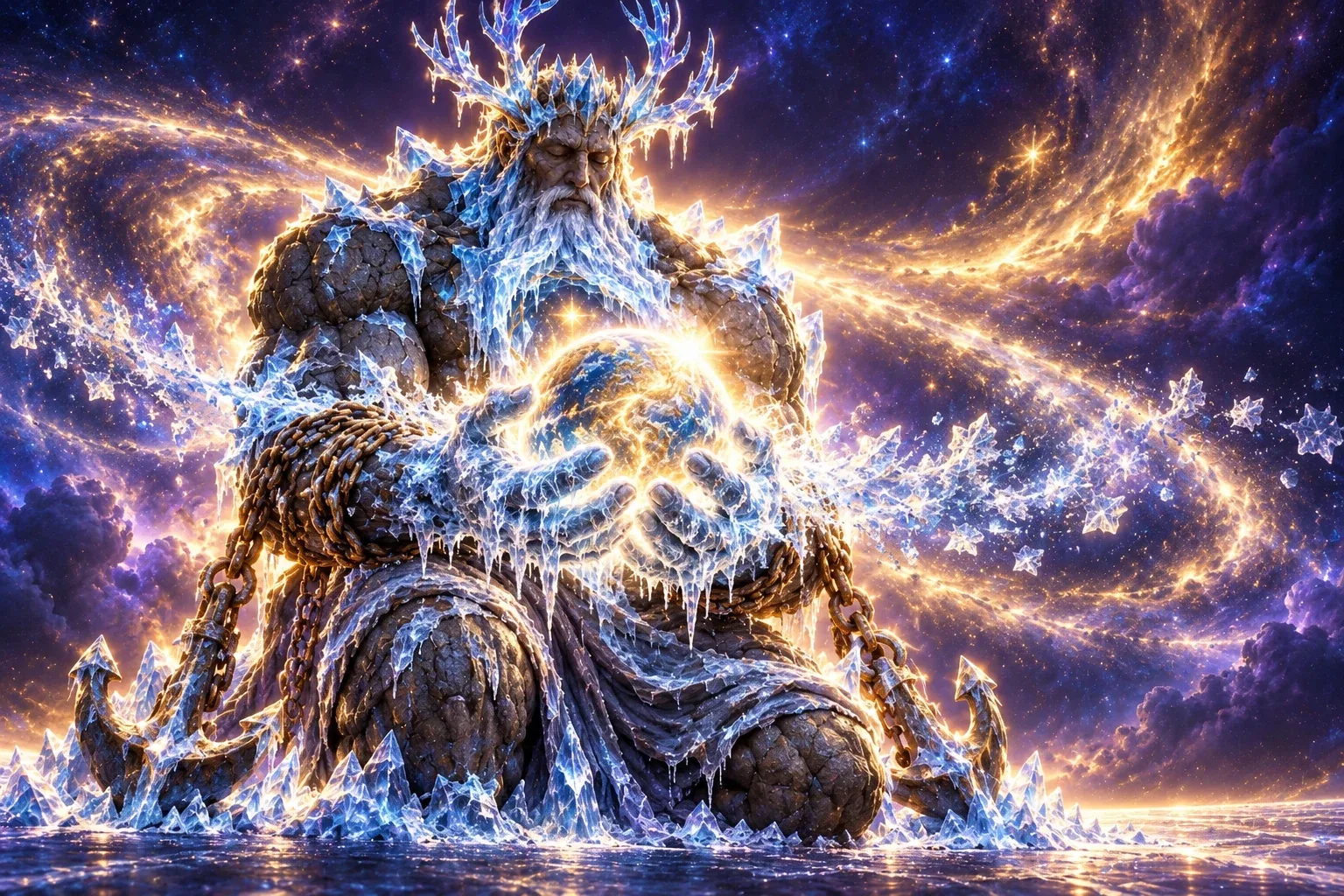
He cupped a young world between his hands and bowed his head over it, and frost spread outward from his fingers, and where the frost went, nothing changed. Decay halted. Motion halted. Even Sethe's turning halted. The world in his hands would remain as it was, forever.
His is the oldest kind of love. Do not change. Do not leave.
So there were four.
Vael lit creation. Orrun measured it and raised the frame on which it hung. Sethe set it turning. Kharn held fast the parts of it that mattered most. And the cosmos that grew between them was the most beautiful thing that has ever been: stars in golden rings, roads of light between them, slow spirals of sand and time, worlds held safe in frost.
This was the Elder Age. It is remembered as the golden age, and rightly.
But consider what they were. Vael gave, and could not stop giving, and grew thinner. Orrun drew lines, and could not conceive of a thing his lines could not resolve. Sethe turned all she touched. Kharn held still all he loved.
Turning, and keeping. Each was right. Each was the true answer to a true need of the world.
And nothing had ever needed to choose between them.